
Biosecurity as everyday good practice: what the research says works
Biosecurity fails not because farmers reject it but because it is designed as an ideal rather than a routine. A review of the practice-level evidence on entry control, animal introductions and internal hygiene — and how to score your own farm honestly.
Bouvera Dairy Digest covers preventative herd management only. Nothing here is veterinary advice: diagnosis, treatment and medicine decisions belong with your own herd veterinarian.
Biosecurity is often presented as a disease-specific programme. The research literature suggests it is better understood as general good practice: a set of routines that reduce the probability of any pathogen entering the herd or moving within it. Damiaans et al. (2020) built a risk-based scoring system on exactly that logic, and its value is that it works without naming a target disease.
Internal biosecurity is the weak point
Sarrazin et al. (2014) and Renault et al. (2018) surveyed cattle farms and found the same pattern repeatedly: external measures such as visitor rules score moderately, while internal measures — separating age groups, hygiene between groups, equipment shared between sick and healthy animals, working order from youngest to oldest — score poorly. Internal biosecurity is also the cheaper half, because it is mostly sequence and habit rather than infrastructure.
Design entry control for humans
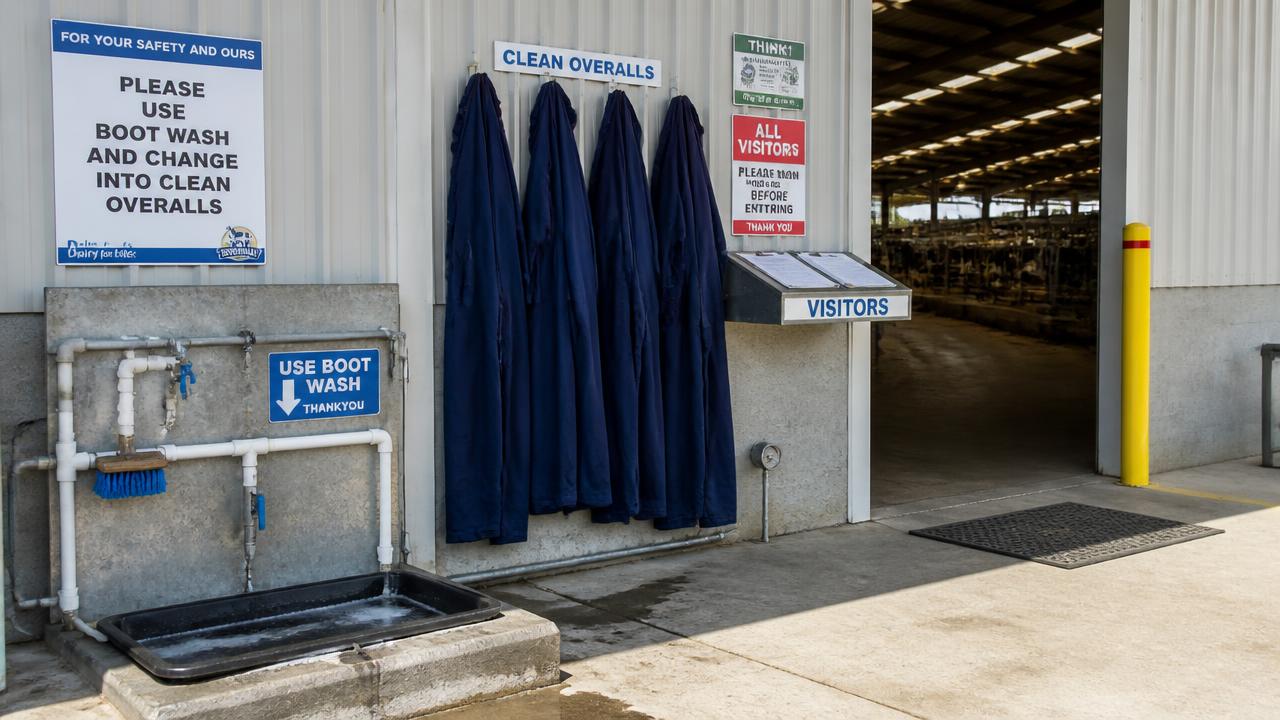
Nöremark & Sternberg-Lewerin (2014) asked the professionals who visit farms what actually determines their behaviour, and the answer was practical: whether clean boots and overalls are available, whether the wash point is at the entrance rather than around the back, and whether it is obvious where to go. A boot wash that is inconvenient is a boot wash that is bypassed.
- One marked entrance, with sign-in, clean boots or covers, and a functioning wash point at the point of entry.
- A hard standing for deliveries and collections that keeps external vehicles off animal areas.
- Quarantine accommodation for introduced animals, physically separate, with its own equipment and handled last.
- Youngest to oldest as the standing daily work order, with separate or cleaned equipment between groups.
- Rapid, defined handling of sick and dead stock, away from feed and young animals.
Movements carry the most risk
Purchased animals, returning show cattle, shared machinery and shared labour are the highest-probability routes into a herd. A closed-herd policy, where the business model allows it, remains the single most effective biosecurity decision available. Where animals must be introduced, an agreed quarantine period and a health-status conversation before purchase — with your veterinarian involved in defining the requirements — is the standard of practice.
Score, don't guess
Use a structured scoring framework once a year, involve everyone who works on the farm, and record the score. The score's absolute value matters less than its trend and than the discussion it forces about which routines have quietly lapsed.
- Damiaans, B., Renault, V., Sarrazin, S., Berge, A. C., Pardon, B., Ribbens, S., Saegerman, C., & Dewulf, J. (2020). A risk-based scoring system to quantify biosecurity in cattle production. Preventive Veterinary Medicine, 179, 104992. https://doi.org/10.1016/j.prevetmed.2020.104992
- Sarrazin, S., Cay, A. B., Laureyns, J., & Dewulf, J. (2014). A survey on biosecurity and management practices in selected Belgian cattle farms. Preventive Veterinary Medicine, 117(1), 129–139. https://doi.org/10.1016/j.prevetmed.2014.07.014
- Renault, V., Damiaans, B., Sarrazin, S., Humblet, M. F., Lomba, M., Ribbens, S., Riocreux, F., Koenen, F., Cardoen, S., Dewulf, J., & Saegerman, C. (2018). Biosecurity practices in Belgian cattle farming: Level of implementation, constraints and weaknesses. Transboundary and Emerging Diseases, 65(5), 1246–1261. https://doi.org/10.1111/tbed.12865
- Nöremark, M., & Sternberg-Lewerin, S. (2014). On-farm biosecurity as perceived by professionals visiting Swedish farms. Acta Veterinaria Scandinavica, 56, 28. https://doi.org/10.1186/1751-0147-56-28