
Infectious hoof health: hygiene, footbath design and the prevention loop
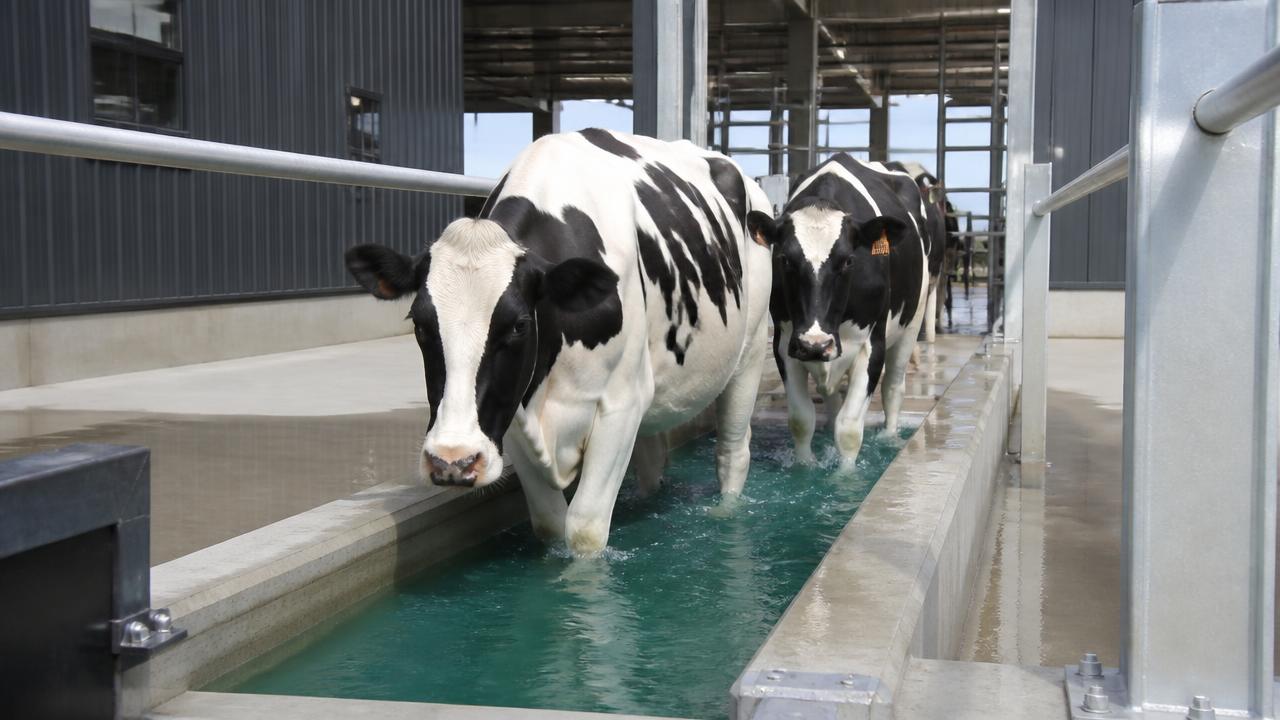
Digital dermatitis is an environmental hygiene problem expressed in the hoof. A review of alley cleanliness, footbath dimensions and the monitoring cadence that keeps prevalence low without escalating chemistry.
Bouvera Dairy Digest covers preventative herd management only. Nothing here is veterinary advice: diagnosis, treatment and medicine decisions belong with your own herd veterinarian.
Digital dermatitis has moved from a curiosity to an endemic feature of freestall dairying across Europe and North America. Solano et al. (2016) recorded it as one of the most prevalent foot lesions in surveyed herds, and Palmer & O'Connell (2015) reviewed the risk-factor literature: hygiene, moisture and slurry contact time dominate, with substantial between-animal variation in susceptibility.
Clean floors do more than any chemistry
The exposure that matters is how many hours per day a hoof stands in slurry. Scraping frequency, alley slope, crossover design and drainage are therefore the primary controls. A herd that scrapes every two hours and one that scrapes twice a day are running fundamentally different hygiene programmes regardless of what is in the footbath.
Footbath design is measurable
Cook (2017) set out the design logic clearly: a bath should be long enough that each rear foot is immersed at least twice per pass, deep enough to cover the heel bulbs, narrow enough to prevent cows from stepping around it, and refreshed on a cow-count basis rather than a calendar. Baths that are too short are the most common design fault in the field, and no chemistry compensates for insufficient immersions.
- Bath length of roughly 3–3.7 m to give two immersions per rear foot at normal walking speed.
- Solution depth around 10 cm at the step-in, with step-in height that cows will accept.
- Refresh interval set by cows-per-bath, recorded, not judged by appearance.
- Pre-bath cleanliness — a bath is a hygiene tool, not a washing facility.
Protect the entry point
Heifers entering the milking group are the recurring weak point: a clean youngstock group meeting an endemic milking herd produces a wave of new lesions. Quarantine-style separation of heifer walkways, dedicated hygiene for the heifer group and scoring heifers at first entry are the practical protections.
Monitor at the parlour
Scoring feet at the parlour exit — a defined sample, on a fixed cadence, with the same scorer — gives a prevalence trend that management can act on. Scoring only at trimming produces a biased picture, because the cows in the crush are already the selected ones. Any lesion found is recorded and passed to the herd veterinarian or trimmer for the treatment decision; the farm's contribution is the hygiene loop and the numbers.
- Cook, N. B. (2017). A review of the design and management of footbaths for dairy cattle. Veterinary Clinics of North America: Food Animal Practice, 33(2), 195–225. https://doi.org/10.1016/j.cvfa.2017.02.004
- Palmer, M. A., & O'Connell, N. E. (2015). Digital dermatitis in dairy cows: A review of risk factors and potential sources of between-animal variation in susceptibility. Animals, 5(3), 512–535. https://doi.org/10.3390/ani5030369
- Solano, L., Barkema, H. W., Jacobs, C., & Orsel, K. (2016). Validation of the M-stage scoring system for digital dermatitis on dairy cows in the milking parlor. Journal of Dairy Science, 100(2), 1592–1603. https://doi.org/10.3168/jds.2016-11365
- Cook, N. B., Rieman, J., Gomez, A., & Burgi, K. (2012). Observations on the design and use of footbaths for the control of infectious hoof disease in dairy cattle. The Veterinary Journal, 193(3), 669–673. https://doi.org/10.1016/j.tvjl.2012.06.051