Dry matter intake: the master variable of milk production
Every kilogram of extra dry matter the cow eats can support roughly two more kilograms of milk. What drives intake, what limits it, and how to measure it.
Bouvera Dairy Digest covers nutrition management principles only.
Dry matter intake (DMI) determines how many nutrients a cow actually receives. A perfectly formulated ration that is not eaten does not make milk.
What controls intake
Allen (2000) described two main controls: physical fill from slowly digested fibre, and metabolic signals from fuels such as propionate oxidised in the liver. Early-lactation cows are often limited by fill, while later in lactation metabolic satiety dominates.
Management drives intake
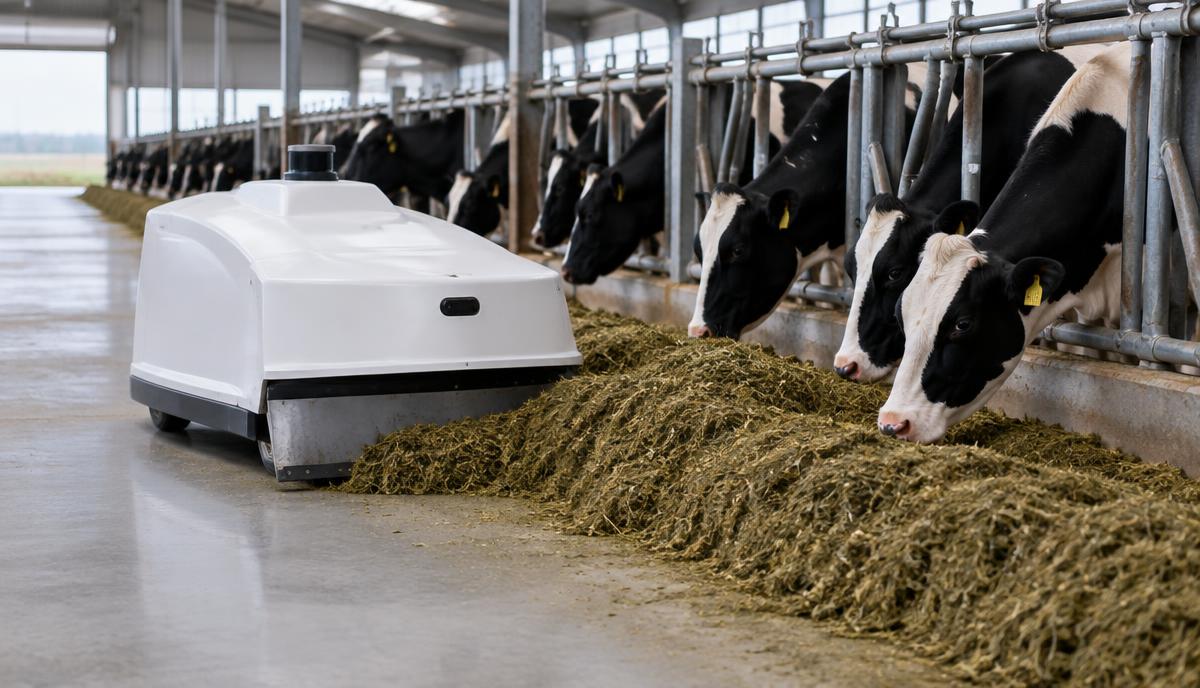
- Feed available at all times, with regular push-ups.
- Enough feed-fence space so subordinate cows can eat (Grant & Albright, 2001).
- Fresh feed delivered at consistent times.
- Comfortable stalls and heat abatement — heat stress cuts intake.
- Clean, abundant water at all times.
Measure it
Group DMI = (feed delivered × DM%) − (refusals × DM%), divided by cows in the pen. Compare it with predicted intake from NASEM (2021); persistent gaps point to ration, access or health issues.
- Allen, M. S. (2000). Effects of diet on short-term regulation of feed intake by lactating dairy cattle. Journal of Dairy Science, 83(7), 1598–1624. https://doi.org/10.3168/jds.S0022-0302(00)75030-2
- Grant, R. J., & Albright, J. L. (2001). Effect of animal grouping on feeding behavior and intake of dairy cattle. Journal of Dairy Science, 84(E. Suppl.), E156–E163. https://doi.org/10.3168/jds.S0022-0302(01)70210-X
- National Academies of Sciences, Engineering, and Medicine (2021). Nutrient Requirements of Dairy Cattle: Eighth Revised Edition. The National Academies Press. https://doi.org/10.17226/25806