Feed quality: the foundation every ration is built on
No formulation can rescue poor forage. What feed quality really means — digestibility, fermentation, contamination and consistency — and why it sets the ceiling for milk from home-grown feed.
Bouvera Dairy Digest covers nutrition management principles only.
Feed quality is the share of a feed's nutrients that the cow can actually extract and turn into milk, health and fertility. For most dairy rations, forage supplies 50–60% of the dry matter, so forage quality decides how much expensive concentrate is needed to reach a given yield.
Digestibility drives intake and milk
Oba and Allen (1999) showed that each one-unit increase in in-vitro NDF digestibility of forage was associated with about 0.17 kg more dry matter intake and 0.25 kg more 4% fat-corrected milk per day. Highly digestible fibre clears the rumen faster, leaving room for the next meal.
Harvest timing
As grasses and legumes mature, lignin increases and digestibility falls. Cutting at the right stage is usually the single most valuable quality decision a farm makes each season — long before any feed reaches the mixer.
Hidden quality losses
- Soil contamination raises ash and dilutes energy; aim for clean cutting heights.
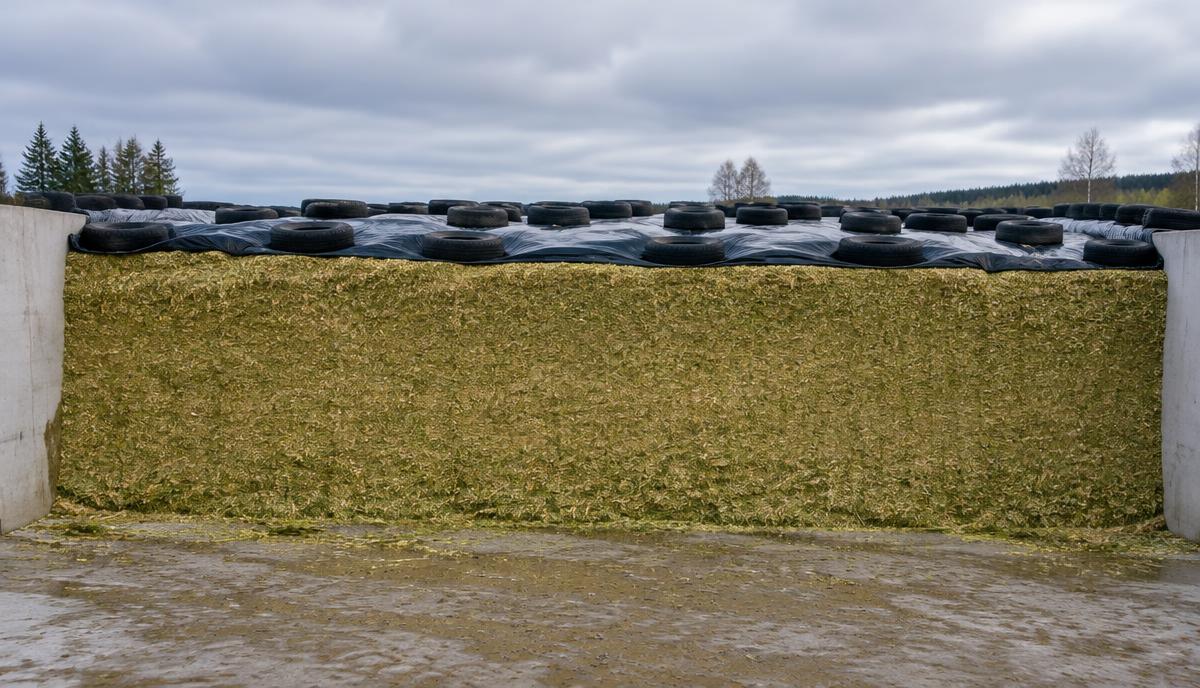
- Aerobic spoilage at the silage face destroys sugars and may produce moulds.
- Mycotoxins can depress intake and immunity; screen suspect batches (Gallo et al., 2015).
- Variation between loads unsettles the rumen even when averages look fine.
- Oba, M., & Allen, M. S. (1999). Evaluation of the importance of the digestibility of neutral detergent fiber from forage: Effects on dry matter intake and milk yield of dairy cows. Journal of Dairy Science, 82(3), 589–596. https://doi.org/10.3168/jds.S0022-0302(99)75271-9
- Gallo, A., Giuberti, G., Frisvad, J. C., Bertuzzi, T., & Nielsen, K. F. (2015). Review on mycotoxin issues in ruminants: Occurrence in forages, effects of mycotoxin ingestion on health status and animal performance and practical strategies to counteract their negative effects. Toxins, 7(8), 3057–3111. https://doi.org/10.3390/toxins7083057
- Kung, L., Shaver, R. D., Grant, R. J., & Schmidt, R. J. (2018). Silage review: Interpretation of chemical, microbial, and organoleptic components of silages. Journal of Dairy Science, 101(5), 4020–4033. https://doi.org/10.3168/jds.2017-13909