
Fibre length: building the rumen mat without limiting intake
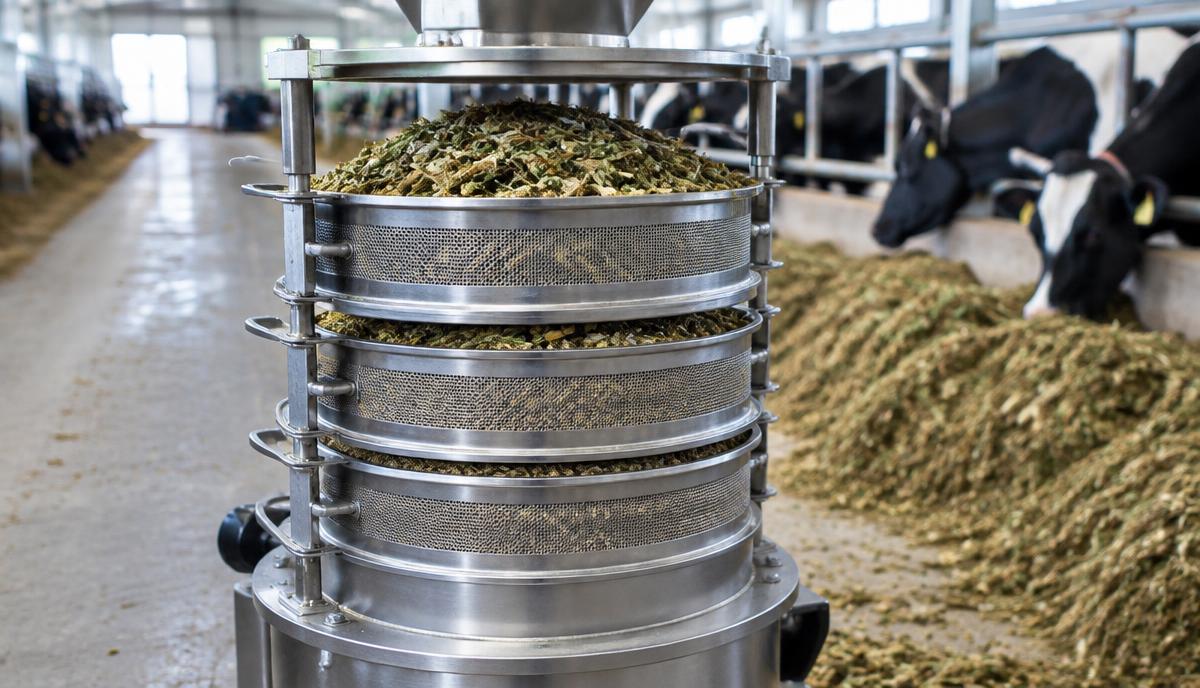
Particle length decides how much the cow chews, how well she buffers her rumen and how much she can eat. A practical review of physically effective fibre.
Bouvera Dairy Digest covers nutrition management principles only.
Mertens (1997) introduced physically effective NDF (peNDF) to describe the part of fibre that stimulates chewing and forms the floating rumen mat. Chewing produces saliva, the cow's natural buffer against low rumen pH.
Too short
Finely chopped rations reduce rumination and saliva flow and increase the risk of subacute ruminal acidosis and low milk fat. Zebeli et al. (2012) suggested around 30–33% peNDF (>1.18 mm) in ration dry matter supports a stable rumen.
Too long
Overly long forage encourages sorting and can restrict intake through gut fill, especially in early lactation (Allen, 2000).
- Shake the delivered TMR with a particle separator — same operator, same method.
- Compare fresh feed with refusals to detect sorting.
- Agree theoretical chop length with your contractor before harvest.
- Mertens, D. R. (1997). Creating a system for meeting the fiber requirements of dairy cows. Journal of Dairy Science, 80(7), 1463–1481. https://doi.org/10.3168/jds.S0022-0302(97)76075-2
- Zebeli, Q., Aschenbach, J. R., Tafaj, M., Boguhn, J., Ametaj, B. N., & Drochner, W. (2012). Invited review: Role of physically effective fiber and estimation of dietary fiber adequacy in high-producing dairy cattle. Journal of Dairy Science, 95(3), 1041–1056. https://doi.org/10.3168/jds.2011-4421
- Allen, M. S. (2000). Effects of diet on short-term regulation of feed intake by lactating dairy cattle. Journal of Dairy Science, 83(7), 1598–1624. https://doi.org/10.3168/jds.S0022-0302(00)75030-2