New feeds on the global market: insects, algae and upcycled by-products
Volatile prices, climate targets and circular-economy policies are bringing new ingredients into dairy rations. A look at what is emerging and what the evidence says.
Bouvera Dairy Digest covers nutrition management principles only.
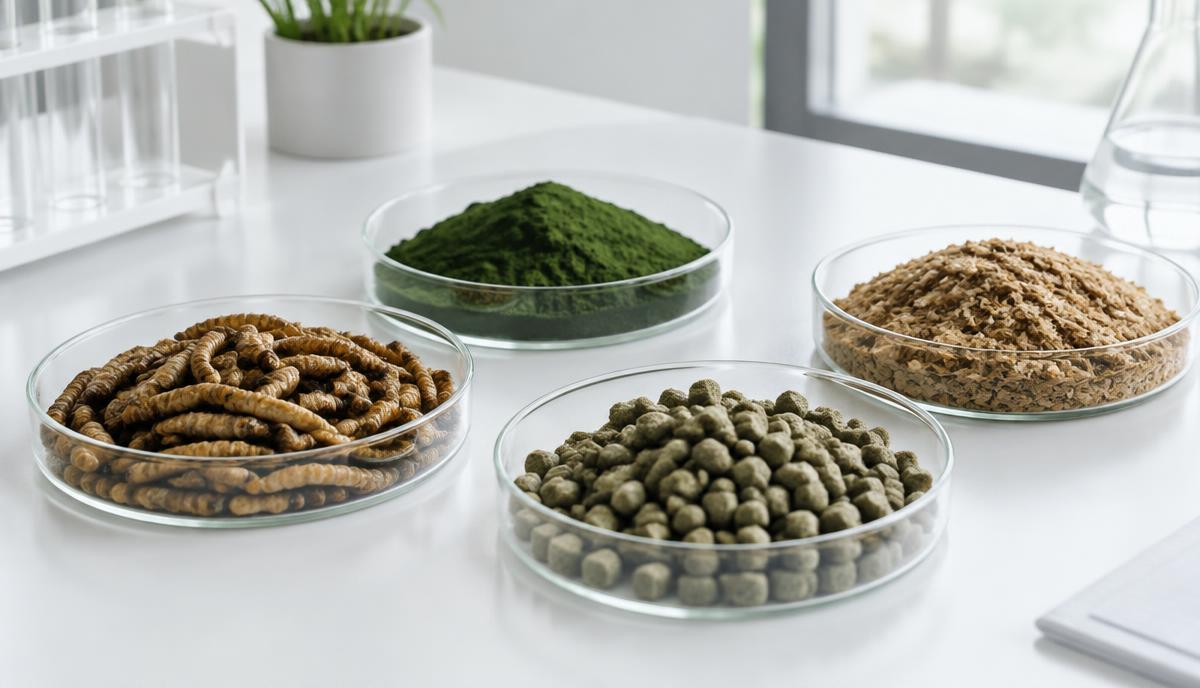
Soybean meal and cereals dominate dairy rations, but their prices and environmental footprint are pushing the industry to explore alternatives. Makkar (2018) reviewed how novel feeds could contribute to more sustainable livestock systems.
Insect meals
Black soldier fly larvae can be reared on organic residues and are rich in protein and fat. Research in ruminants is still limited, and regulations on feeding insects to cattle differ between regions — in the EU, for example, specific rules apply.
Microalgae and seaweed
Microalgae can supply omega-3 fatty acids, and the red seaweed Asparagopsis has been shown to sharply reduce enteric methane in trials (Roque et al., 2019), though long-term effects, palatability and residue questions are still being studied.
Single-cell proteins and by-products
Bacterial and yeast proteins produced by fermentation, and upcycled by-products from brewing, bioethanol and food processing, are increasingly traded globally. Consistency of composition and storage stability are key questions — sample every new load.
- Check local feed legislation before using a new ingredient.
- Introduce new feeds gradually and monitor intake and milk components.
- Ask suppliers for full analyses and contaminant tests.
- Makkar, H. P. S. (2018). Review: Feed demand landscape and implications of food-not feed strategy for food security and climate change. Animal, 12(8), 1744–1754. https://doi.org/10.1017/S175173111700324X
- Roque, B. M., Salwen, J. K., Kinley, R., & Kebreab, E. (2019). Inclusion of Asparagopsis armata in lactating dairy cows' diet reduces enteric methane emission by over 50 percent. Journal of Cleaner Production, 234, 132–138. https://doi.org/10.1016/j.jclepro.2019.06.193
- van Huis, A. (2013). Potential of insects as food and feed in assuring food security. Annual Review of Entomology, 58, 563–583. https://doi.org/10.1146/annurev-ento-120811-153704