
Water intake and hygiene: the first nutrient
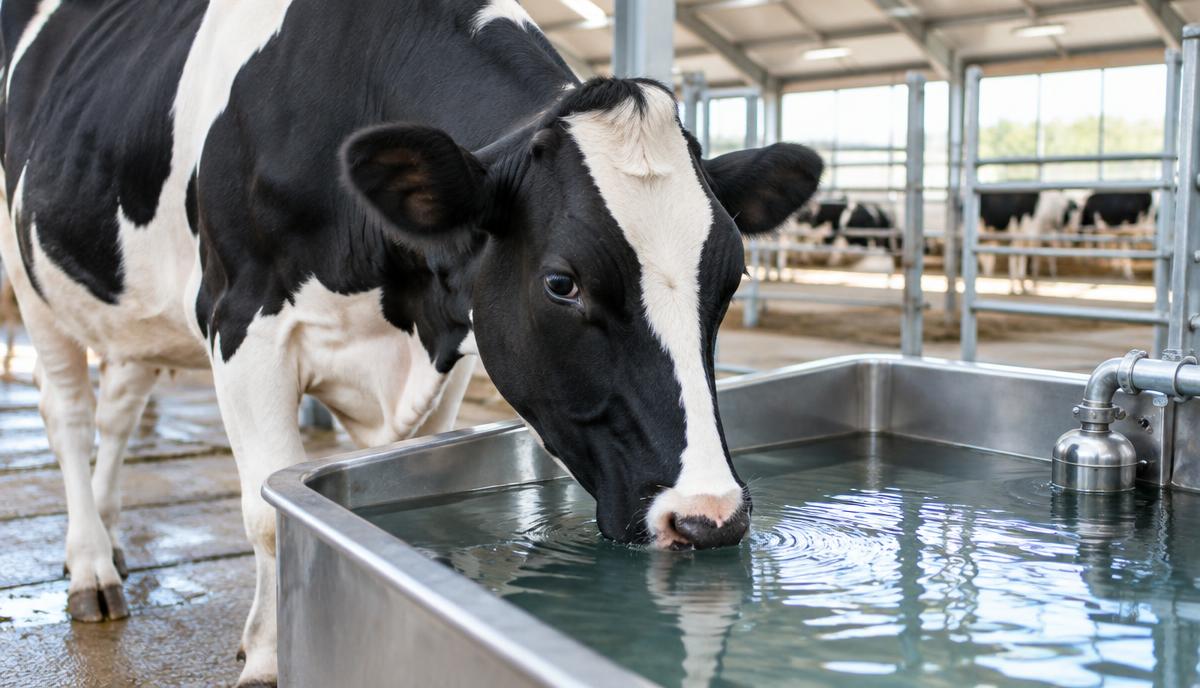
A lactating cow can drink 80–150 litres a day. How much water cows need, from calves on day one to high yielders, and why trough hygiene directly affects feed intake.
Bouvera Dairy Digest covers nutrition management principles only.
Water is the nutrient cows need in the largest amount. Meyer et al. (2004) and Cardot, Le Roux and Jurjanz (2008) show that water intake rises with milk yield, dry matter intake, ambient temperature and dietary sodium and potassium. Restricting water quickly reduces feed intake and milk yield. Calves need fresh, clean water from day one as well — Wickramasinghe et al. (2019) found that offering water from birth improved growth and feed intake.
Access and flow
- Cows drink most right after milking and feeding — place troughs on those routes.
- Provide generous trough space so several cows can drink at once.
- Ensure refill flow is fast enough that troughs never run low at peak times.
Hygiene
Feed residues, saliva and manure in troughs feed bacteria and biofilm. Dirty or warm water reduces drinking and therefore intake. Clean troughs frequently — daily in summer — and test water for bacteria, nitrates, sulphates and iron at least yearly (Beede, 2012).
- Meyer, U., Everinghoff, M., Gädeken, D., & Flachowsky, G. (2004). Investigations on the water intake of lactating dairy cows. Livestock Production Science, 90(2–3), 117–121. https://doi.org/10.1016/j.livprodsci.2004.03.005
- Cardot, V., Le Roux, Y., & Jurjanz, S. (2008). Drinking behavior of lactating dairy cows and prediction of their water intake. Journal of Dairy Science, 91(6), 2257–2264. https://doi.org/10.3168/jds.2007-0204
- Wickramasinghe, H. K. J. P., Kramer, A. J., & Appuhamy, J. A. D. R. N. (2019). Drinking water intake of newborn dairy calves and its effects on feed intake, growth performance, health status, and nutrient digestibility. Journal of Dairy Science, 102(1), 377–387. https://doi.org/10.3168/jds.2018-15579
- Beede, D. K. (2012). What will our ruminants drink? Animal Frontiers, 2(2), 36–43. https://doi.org/10.2527/af.2012-0040