
Body condition and energy balance: the fertility decision made before calving
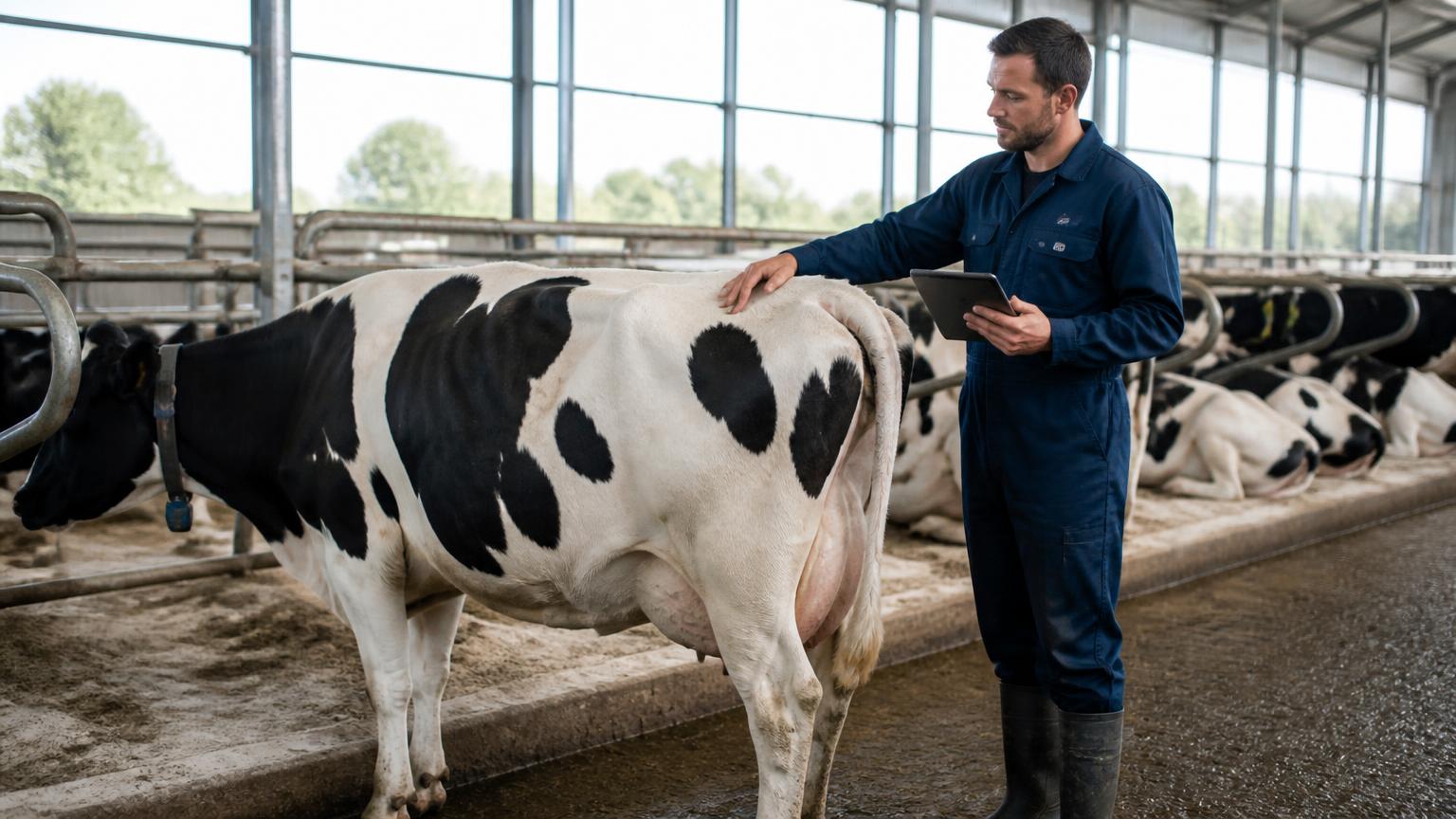
Conception in the third month of lactation is largely determined by what happened in the three weeks either side of calving. A review of condition-score change, the nadir of energy balance and the management levers that move both.
Bouvera Dairy Digest covers reproductive management only. Nothing here is veterinary advice: diagnosis, hormonal protocols, medicines and treatment decisions belong with your own herd veterinarian.
Of all the variables a herd manager controls, body condition change across the transition period has among the strongest and most repeatable associations with subsequent fertility. Roche et al. (2009) reviewed the field comprehensively and the conclusion has held: it is the magnitude and speed of condition loss after calving, rather than the absolute score at any single point, that predicts conception.
What the numbers look like
- Calving condition in the region of 3.0–3.25 (five-point scale) is widely supported; both over- and under-conditioned cows at calving do worse.
- Loss of more than about 0.5 to 1.0 units in early lactation is consistently associated with delayed cyclicity and reduced conception.
- Cows that reach their energy-balance nadir earlier resume ovarian cyclicity earlier, and early resumption is one of the best single predictors of pregnancy by 150 days.
- Body condition measured automatically by camera now makes weekly herd-level tracking realistic without operator drift.
The mechanism in one paragraph
Deep negative energy balance suppresses pulsatile LH secretion, limits follicular oestradiol production and delays first ovulation. It also alters the follicular fluid and oocyte environment in ways that persist for weeks after energy balance itself has recovered — which is why a cow that had a difficult fresh period can still show poor conception at 90 days even though she now looks well. Butler's (2003) synthesis of this remains the clearest account for a practical audience.
What actually changes the curve
In Bouvera's client work the reproducible levers are unglamorous: feed-bunk space per cow in the close-up and fresh pens, stable group composition in the three weeks before calving, consistent ration delivery and push-up frequency, and enough lying space that eating is not competing with resting. These are housing and routine decisions, not ration formulation decisions, and they move intake at exactly the point where intake determines fertility three months later.
Monitoring that pays
Score, or camera-measure, at dry-off, at calving and at 30 and 60 days in milk. Report the change, not the level. A herd where more than a fifth of cows lose a full condition unit by 60 days has a transition-management problem that will appear in the breeding figures one quarter later, and correcting it there is far cheaper than correcting it in the breeding programme.
- Roche, J. R., Friggens, N. C., Kay, J. K., Fisher, M. W., Stafford, K. J., & Berry, D. P. (2009). Invited review: Body condition score and its association with dairy cow productivity, health, and welfare. Journal of Dairy Science, 92(12), 5769–5801. https://doi.org/10.3168/jds.2009-2431
- Butler, W. R. (2003). Energy balance relationships with follicular development, ovulation and fertility in postpartum dairy cows. Livestock Production Science, 83(2–3), 211–218. https://doi.org/10.1016/S0301-6226(03)00112-X
- Carvalho, P. D., Souza, A. H., Amundson, M. C., Hackbart, K. S., Fuenzalida, M. J., Herlihy, M. M., Ayres, H., Dresch, A. R., Vieira, L. M., Guenther, J. N., Grummer, R. R., Fricke, P. M., Shaver, R. D., & Wiltbank, M. C. (2014). Relationships between fertility and postpartum changes in body condition and body weight in lactating dairy cows. Journal of Dairy Science, 97(6), 3666–3683. https://doi.org/10.3168/jds.2013-7809
- Santos, J. E. P., Bisinotto, R. S., Ribeiro, E. S., Lima, F. S., Greco, L. F., Staples, C. R., & Thatcher, W. W. (2010). Applying nutrition and physiology to improve reproduction in dairy cattle. Society of Reproduction and Fertility Supplement, 67, 387–403. https://doi.org/10.5661/RDR-VII-387