
Heat stress and fertility: the seasonal loss that is now a northern problem too
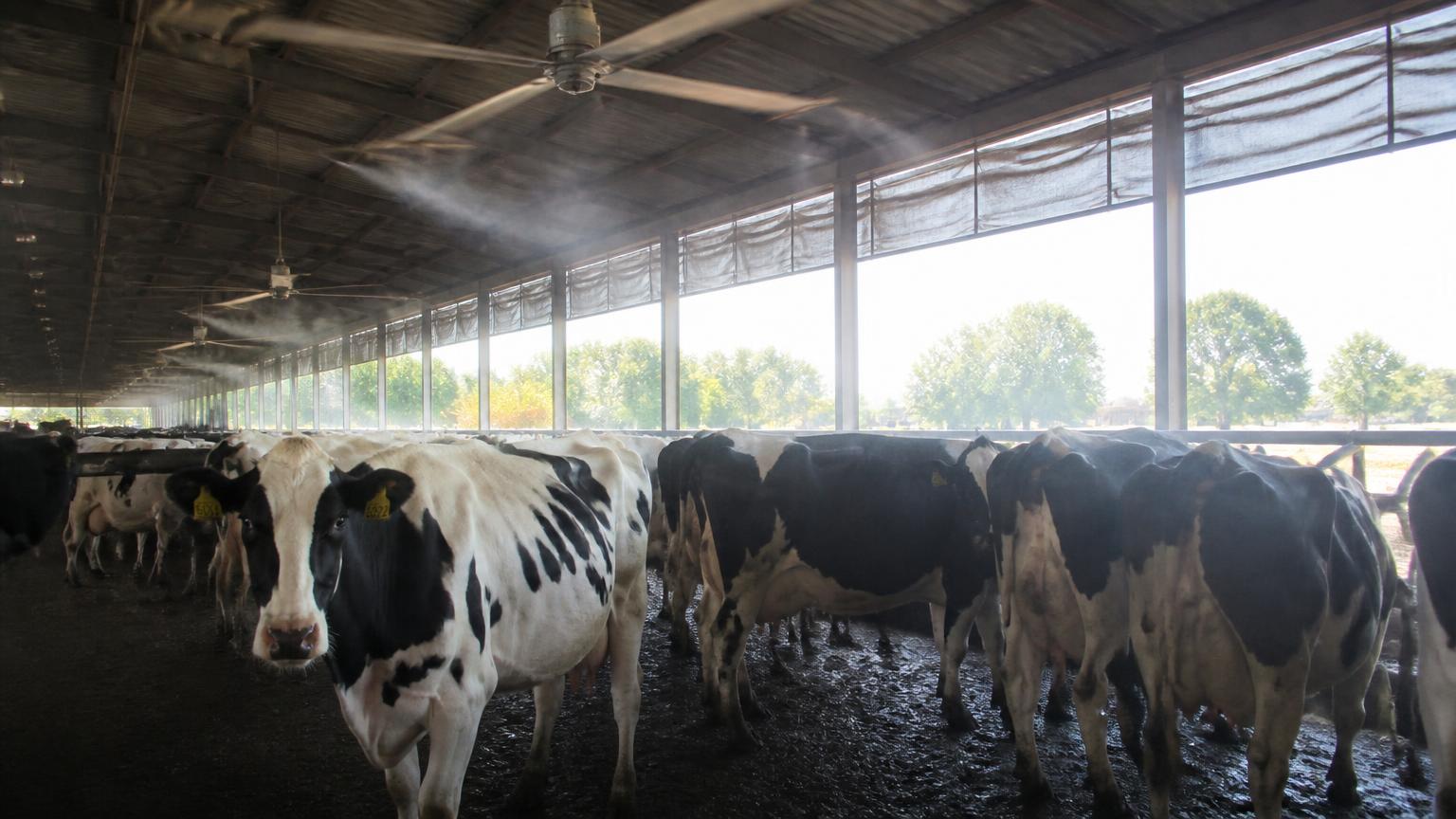
Summer conception depressions used to be a Mediterranean concern. With rising summer temperature-humidity indices in northern Europe, the seasonal fertility curve is flattening herds that have never cooled before.
Bouvera Dairy Digest covers reproductive management only. Nothing here is veterinary advice: diagnosis, hormonal protocols, medicines and treatment decisions belong with your own herd veterinarian.
Heat stress affects reproduction at a lower threshold than it affects milk yield. Milk loss becomes visible around a temperature-humidity index of 68; measurable reductions in conception and oestrus expression begin at or below that point, and in high-yielding cows the effective threshold is lower still because metabolic heat production is higher.
Three overlapping mechanisms
- Behavioural: expressed oestrus is shorter and less intense, so detection rate falls before conception rate does.
- Oocyte-level: follicles developing during a heat event carry damage that only becomes visible when those oocytes are ovulated weeks later.
- Embryonic: the early embryo is highly sensitive to elevated uterine temperature in the first days after fertilisation, which is where much of the conception loss occurs.
The carry-over problem
Because follicular development takes several weeks, the reproductive consequences of a July heat event appear in September conception data. Roth (2020) reviewed this delayed effect and its implications for management: a herd that judges its cooling by summer conception alone will systematically underestimate the damage, and a herd that stops cooling the moment the weather breaks loses part of the benefit it has already paid for.
Where to spend first
When cooling capacity has to be prioritised, the evidence supports the holding area and the return lane before the freestall rows, because that is where cows are most densely packed and least able to dissipate heat. After that, the close-up dry pen — in utero heat stress has documented lifetime effects on the resulting heifer's own production and fertility (Dahl et al., 2020) — and then the high-group feed line. Fans alone move less heat than fans combined with wetting; the combination of soaking and forced air is the effective unit.
Northern Europe specifically
Barns in Sweden, Denmark, the Netherlands and the UK were largely designed for heat conservation, with limited ridge opening and low air exchange in still conditions. Retrofitted cooling in these buildings usually starts with air movement rather than evaporative capacity, and the first thing to measure is not outdoor temperature but THI at cow height inside the barn, where the figure is often several units higher than the weather station suggests.
- De Rensis, F., Garcia-Ispierto, I., & López-Gatius, F. (2015). Seasonal heat stress: Clinical implications and hormone treatments for the fertility of dairy cows. Theriogenology, 84(5), 659–666. https://doi.org/10.1016/j.theriogenology.2015.04.021
- Roth, Z. (2020). Reproductive physiology and endocrinology responses of cows exposed to environmental heat stress — Experiences from the past and lessons for the present. Theriogenology, 155, 150–156. https://doi.org/10.1016/j.theriogenology.2020.05.040
- Dahl, G. E., Tao, S., & Laporta, J. (2020). Heat stress impacts immune status in cows across the life cycle. Frontiers in Veterinary Science, 7, 116. https://doi.org/10.3389/fvets.2020.00116
- Hansen, P. J. (2009). Effects of heat stress on mammalian reproduction. Philosophical Transactions of the Royal Society B, 364(1534), 3341–3350. https://doi.org/10.1098/rstb.2009.0131