
Oestrus detection: what sensors changed, and what they did not
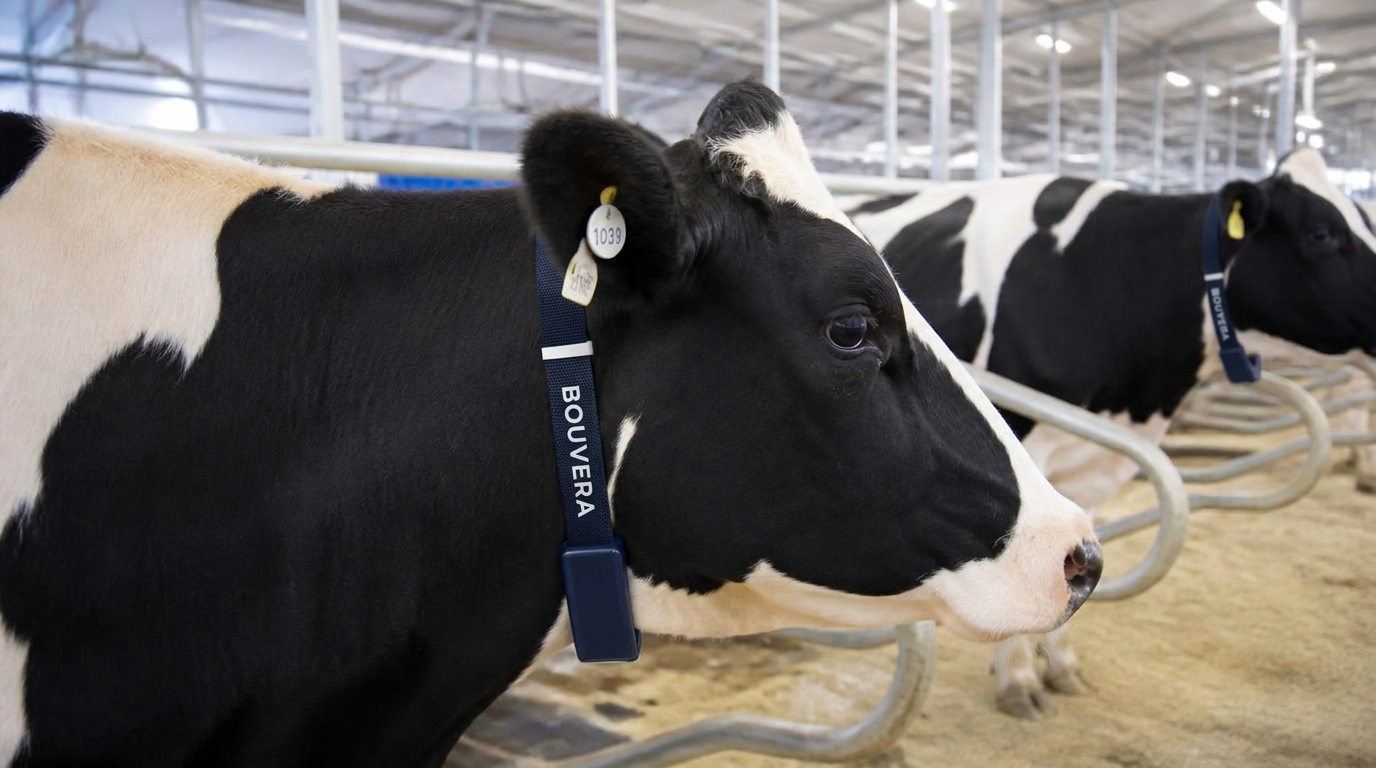
Automated activity monitoring now matches or beats trained visual observation in most commercial settings — but detection rate is only half the equation. A review of sensitivity, specificity and the timing question that still decides conception.
Bouvera Dairy Digest covers reproductive management only. Nothing here is veterinary advice: diagnosis, hormonal protocols, medicines and treatment decisions belong with your own herd veterinarian.
Oestrus detection is the single largest controllable input into a herd's pregnancy rate, and it has changed more in the last fifteen years than in the previous fifty. The underlying problem is well documented: as milk yield rose, the duration and intensity of expressed oestrus fell. Lopez et al. (2004) showed standing oestrus duration declining with increasing yield, and Roelofs et al. (2010) summarised the consequence — visual observation alone, at realistic observation frequencies, misses a large share of heats in modern herds.
What the sensors actually deliver
Accelerometer-based activity systems, whether neck-, leg- or ear-mounted, typically report detection sensitivity in the region of 70–90% with specificity above 90% in validation studies (Fricke et al., 2014; Mayo et al., 2019). Adding rumination or lying-time channels improves specificity more than sensitivity, because it removes false positives caused by non-oestrous activity spikes such as pen moves and regrouping.
Detection is not the same as timing
Ovulation occurs roughly 24–32 hours after the onset of the activity increase, and fertile life of both oocyte and sperm is short. Systems that report an alert time rather than a detection event therefore allow service to be placed against a physiological reference point rather than a milking-time convention. Herds that switch from twice-daily visual checks to alert-based timing commonly gain several percentage points of conception rate without changing anything else.
The barn is part of the sensor
- Slippery concrete suppresses mounting behaviour and blunts the activity signal — grooving and rubber matting measurably restore expression.
- Lame cows express oestrus far less; lameness prevalence and heat detection rate are not independent numbers.
- Overstocking reduces both activity expression and the time cows have to interact.
- Group composition matters: cows in oestrus need other cows around them to express sexual behaviour.
A working audit
Calculate heat detection rate as the proportion of eligible cows served in each 21-day period, and hold it against the herd's lameness prevalence and flooring condition before blaming the technology. In practice, most disappointing sensor installations are barn problems: the alerts are accurate, but the cows cannot express what the sensor is designed to measure.
- Lopez, H., Satter, L. D., & Wiltbank, M. C. (2004). Relationship between level of milk production and estrous behavior of lactating dairy cows. Animal Reproduction Science, 81(3–4), 209–223. https://doi.org/10.1016/j.anireprosci.2003.10.009
- Roelofs, J., López-Gatius, F., Hunter, R. H. F., van Eerdenburg, F. J. C. M., & Hanzen, C. (2010). When is a cow in estrus? Clinical and practical aspects. Theriogenology, 74(3), 327–344. https://doi.org/10.1016/j.theriogenology.2010.02.016
- Fricke, P. M., Carvalho, P. D., Giordano, J. O., Valenza, A., Lopes, G., & Amundson, M. C. (2014). Expression and detection of estrus in dairy cows: The role of new technologies. Animal, 8(s1), 134–143. https://doi.org/10.1017/S1751731114000299
- Mayo, L. M., Silvia, W. J., Ray, D. L., Jones, B. W., Stone, A. E., Tsai, I. C., Clark, J. D., Bewley, J. M., & Heersche, G. (2019). Automated estrous detection using multiple commercial precision dairy monitoring technologies in synchronized dairy cows. Journal of Dairy Science, 102(3), 2645–2656. https://doi.org/10.3168/jds.2018-14738