
Pregnancy diagnosis and pregnancy loss: reading the loss curve honestly
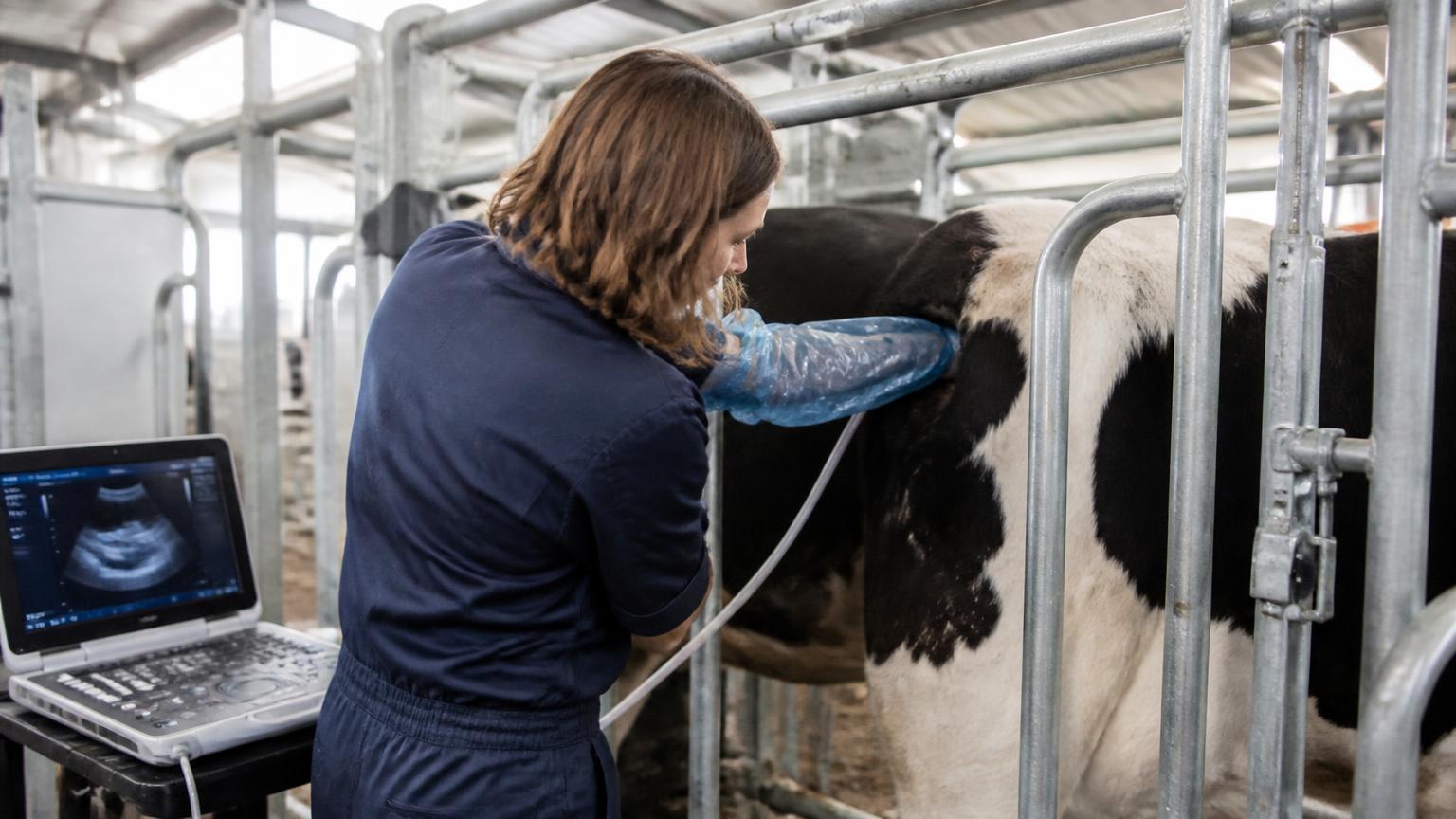
Fertilisation is rarely the problem. Most reproductive loss in lactating dairy cows happens between fertilisation and day 42, and the diagnostic method you choose determines how much of it you can even see.
Bouvera Dairy Digest covers reproductive management only. Nothing here is veterinary advice: diagnosis, hormonal protocols, medicines and treatment decisions belong with your own herd veterinarian.
Fertilisation rates in lactating dairy cows are high — commonly reported above 80% after a well-timed service. Calving rates are far lower. The gap is embryonic and early foetal loss, and the classic description of its distribution by Santos et al. (2004) and the later synthesis by Wiltbank et al. (2016) remain the reference points: the largest single block of loss occurs before day 7, a further substantial share between days 7 and 28, and a smaller but economically significant portion after day 28.
Choosing a diagnostic method
- Transrectal ultrasound from around day 28–32 gives an immediate answer, plus foetal viability, twin detection and, later, sex determination.
- Manual palpation is reliable from around day 35–40 in experienced hands and requires no equipment.
- Pregnancy-associated glycoprotein tests on milk or blood work from around day 28 and need no veterinary visit, but detect placental protein rather than a live foetus, so a recent loss can still test positive for a period.
- In-line progesterone monitoring identifies non-pregnancy earlier than any of the above by detecting the failure of luteal maintenance.
The case for a second check
Late embryonic and early foetal loss between the first diagnosis and 60–70 days runs at several percent in most commercial herds and far higher in heat-stressed or high-producing groups. A herd that diagnoses once at day 32 and does not re-check carries those cows as pregnant for months. A confirmation check at 60–75 days typically finds enough open cows to pay for itself several times over in avoided days open.
Turning loss into information
Record losses by service date, not by detection date. Plotted against service month, the loss curve usually reveals whether the herd has a heat-stress problem, a transition-health problem or a service-timing problem — three causes that produce visually distinct patterns. Recording by detection date obscures all of it.
What not to conclude
A single bad month is noise in most herd sizes. Loss rates should be assessed on rolling twelve-month data with a defined denominator, and any intervention should be judged on a full year. This is one of the areas where reproductive management most often goes wrong: reacting to normal variation with structural change.
- Santos, J. E. P., Thatcher, W. W., Chebel, R. C., Cerri, R. L. A., & Galvão, K. N. (2004). The effect of embryonic death rates in cattle on the efficacy of estrus synchronization programs. Animal Reproduction Science, 82–83, 513–535. https://doi.org/10.1016/j.anireprosci.2004.04.015
- Wiltbank, M. C., Baez, G. M., Garcia-Guerra, A., Toledo, M. Z., Monteiro, P. L. J., Melo, L. F., Ochoa, J. C., Santos, J. E. P., & Sartori, R. (2016). Pivotal periods for pregnancy loss during the first trimester of gestation in lactating dairy cows. Theriogenology, 86(1), 239–253. https://doi.org/10.1016/j.theriogenology.2016.04.037
- Fricke, P. M., Ricci, A., Giordano, J. O., & Carvalho, P. D. (2016). Methods for and implementation of pregnancy diagnosis in dairy cows. Veterinary Clinics of North America: Food Animal Practice, 32(1), 165–180. https://doi.org/10.1016/j.cvfa.2015.09.006
- Diskin, M. G., & Morris, D. G. (2008). Embryonic and early foetal losses in cattle and other ruminants. Reproduction in Domestic Animals, 43(s2), 260–267. https://doi.org/10.1111/j.1439-0531.2008.01171.x