
Cow-calf contact systems: what the evidence base actually says in 2026
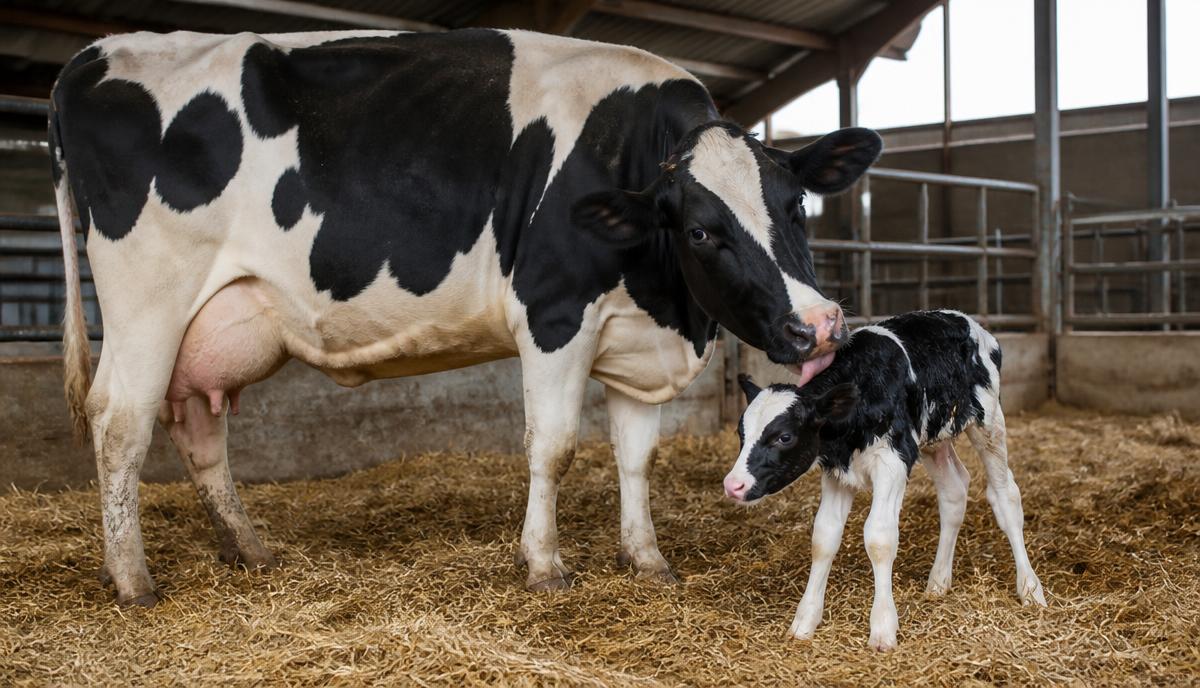
Extended cow-calf contact has moved from a fringe question to an active research programme. What the current literature supports, what remains contested, and what the practical trade-offs look like in commercial herds.
The question of whether dairy calves should stay with their dams — and for how long — has moved from a marginal welfare debate into a serious research programme. Systematic reviews by Beaver et al. (2019) and Sirovnik et al. (2020) synthesise a decade of work; more recent trials (Johnsen et al., 2021; Bertelsen & Jensen, 2023) sharpen the picture on practical system design.
What the evidence supports
The behavioural benefits of extended cow-calf contact are consistent across studies: improved calf solid-feed intake development, better social skills, and reduced abnormal oral behaviour. Growth rates in contact-reared calves are typically equal to or better than artificially reared calves through weaning.
The production trade-off is real
Saleable milk yield during the contact period is reduced — the range in the literature is roughly 4–8 kg per cow per day depending on system design and contact duration. Post-weaning, most studies show yield recovery to control-herd levels, though a small residual deficit persists in some trials.
Separation stress
- Abrupt separation at any age produces measurable distress vocalisations in both dam and calf.
- Two-step weaning (nose-flap followed by separation 5–7 days later) reduces vocalisation and activity spikes substantially.
- Fenceline contact during weaning further reduces the acute stress response.
- Timing beyond 8–12 weeks does not appear to worsen separation stress in most trials.
What decides commercial viability
The farms making cow-calf contact work at scale share three design decisions: a dedicated contact pen with reliable calf-only creep areas, a milking routine that accepts and manages let-down inhibition, and a two-step weaning protocol scheduled into the herd calendar rather than improvised. Without those, the welfare gains are real but the operation drifts.
- Beaver, A., Meagher, R. K., von Keyserlingk, M. A. G., & Weary, D. M. (2019). Invited review: A systematic review of the effects of early separation on dairy cow and calf health. Journal of Dairy Science, 102(7), 5784–5810. https://doi.org/10.3168/jds.2018-15603
- Sirovnik, J., Barth, K., de Oliveira, D., Ferneborg, S., Haskell, M. J., Hillmann, E., Jensen, M. B., Mejdell, C. M., Napolitano, F., Vaarst, M., Verwer, C. M., Waiblinger, S., Zipp, K. A., & Johnsen, J. F. (2020). Methodological terminology and definitions for research and discussion of cow-calf contact systems. Journal of Dairy Research, 87(S1), 108–114. https://doi.org/10.1017/S0022029920000564
- Johnsen, J. F., Zipp, K. A., Kälber, T., de Passillé, A. M., Knierim, U., Barth, K., & Mejdell, C. M. (2021). Is rearing calves with the dam a feasible option for dairy farms? — Current and future research. Applied Animal Behaviour Science, 234, 105144. https://doi.org/10.1016/j.applanim.2020.105144
- Bertelsen, M., & Jensen, M. B. (2023). Behavior of dairy cows with or without contact with their calf: A comprehensive review. Journal of Dairy Science, 106(11), 7538–7552. https://doi.org/10.3168/jds.2023-23345
- Weary, D. M., & Chua, B. (2000). Effects of early separation on the dairy cow and calf: 1. Separation at 6 h, 1 day and 4 days after birth. Applied Animal Behaviour Science, 69(3), 177–188. https://doi.org/10.1016/S0168-1591(00)00128-3