
Environmental enrichment for dairy cows: beyond brushes and pasture
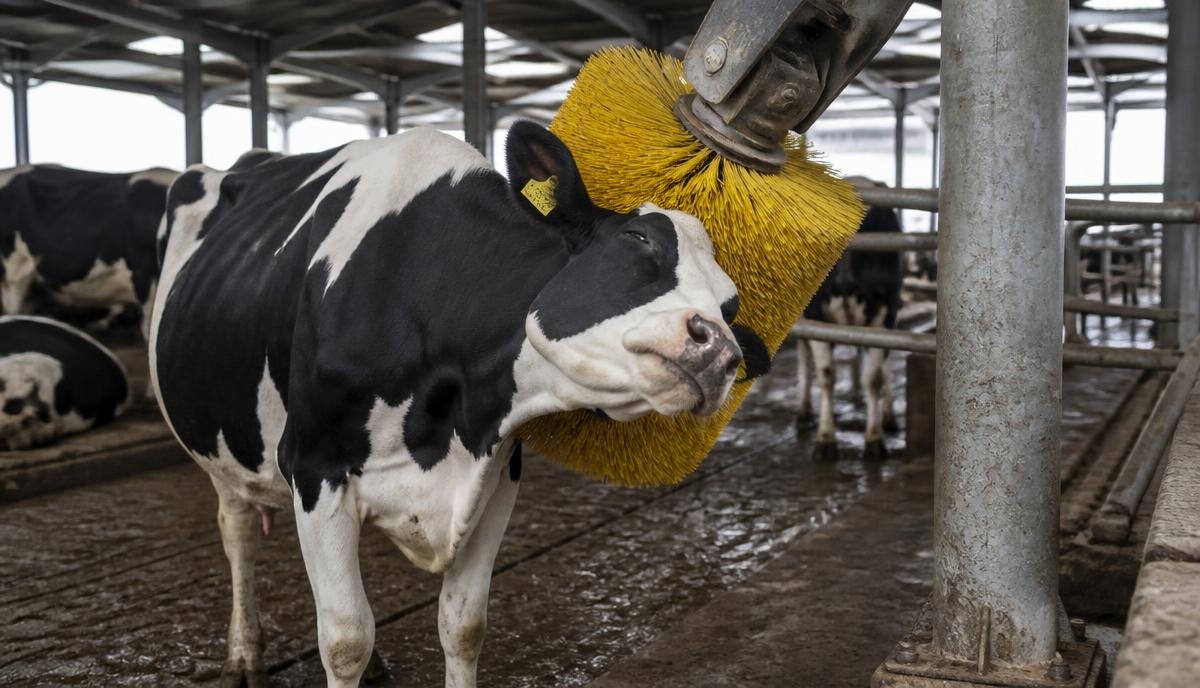
Mechanical brushes are now standard, but the enrichment literature has moved well beyond them. What the current evidence supports for cows, heifers and calves in intensive systems.
Environmental enrichment for dairy cattle has moved from a niche welfare concern to a mainstream design question. The core framing from Newberry (1995) — that enrichment must produce measurable improvements in biological function, not just look enriched to the observer — still governs the current literature. What has changed is the strength of the evidence for specific interventions.
Mechanical brushes: no longer optional
The evidence for automated rotating brushes is now overwhelming. DeVries et al. (2007) and later work by Mandel et al. (2016) show that cows use brushes at high rates when provided, that use is highest in early lactation and around oestrus, and that removal produces frustration behaviours. Brushes are cheap on a per-cow-per-year basis and should be considered a baseline resource rather than an enrichment upgrade.
Social enrichment for calves
For pre-weaned calves the single largest enrichment gain comes from pair or group housing rather than individual pens. Costa et al. (2016) synthesise the cognitive, behavioural and solid-feed intake benefits; the effect sizes are large and consistent enough that individual housing is now difficult to defend on welfare grounds outside a short neonatal isolation window.
Pasture where feasible
Where climate and land base allow it, pasture access remains the most comprehensive enrichment intervention available — combining locomotion, social choice, thermal choice and dietary variety. Charlton and Rutter (2017) document the strong and consistent cow preference for pasture at night, particularly in warm weather, even when a comfortable indoor alternative is available.
Practical additions that move behaviour
- Additional lying-area square metreage beyond the regulatory minimum — the behavioural response curve does not plateau at the legal floor.
- Outdoor loafing yards or covered exercise areas for confinement herds without pasture access.
- Varied forage presentation (long-stem hay alongside the TMR) to support natural feeding motivation.
- Sufficient stocking density at the water trough and feed bunk — competition suppresses the very behaviours enrichment is meant to enable.
- Newberry, R. C. (1995). Environmental enrichment: Increasing the biological relevance of captive environments. Applied Animal Behaviour Science, 44(2–4), 229–243. https://doi.org/10.1016/0168-1591(95)00616-Z
- DeVries, T. J., Vankova, M., Veira, D. M., & von Keyserlingk, M. A. G. (2007). Short communication: Usage of mechanical brushes by lactating dairy cows. Journal of Dairy Science, 90(5), 2241–2245. https://doi.org/10.3168/jds.2006-648
- Mandel, R., Whay, H. R., Klement, E., & Nicol, C. J. (2016). Invited review: Environmental enrichment of dairy cows and calves in indoor housing. Journal of Dairy Science, 99(3), 1695–1715. https://doi.org/10.3168/jds.2015-9875
- Costa, J. H. C., von Keyserlingk, M. A. G., & Weary, D. M. (2016). Invited review: Effects of group housing of dairy calves on behavior, cognition, performance, and health. Journal of Dairy Science, 99(4), 2453–2467. https://doi.org/10.3168/jds.2015-10144
- Charlton, G. L., & Rutter, S. M. (2017). The behaviour of housed dairy cattle with and without pasture access: A review. Applied Animal Behaviour Science, 192, 2–9. https://doi.org/10.1016/j.applanim.2017.05.015