
Heat stress is now a Northern European welfare problem
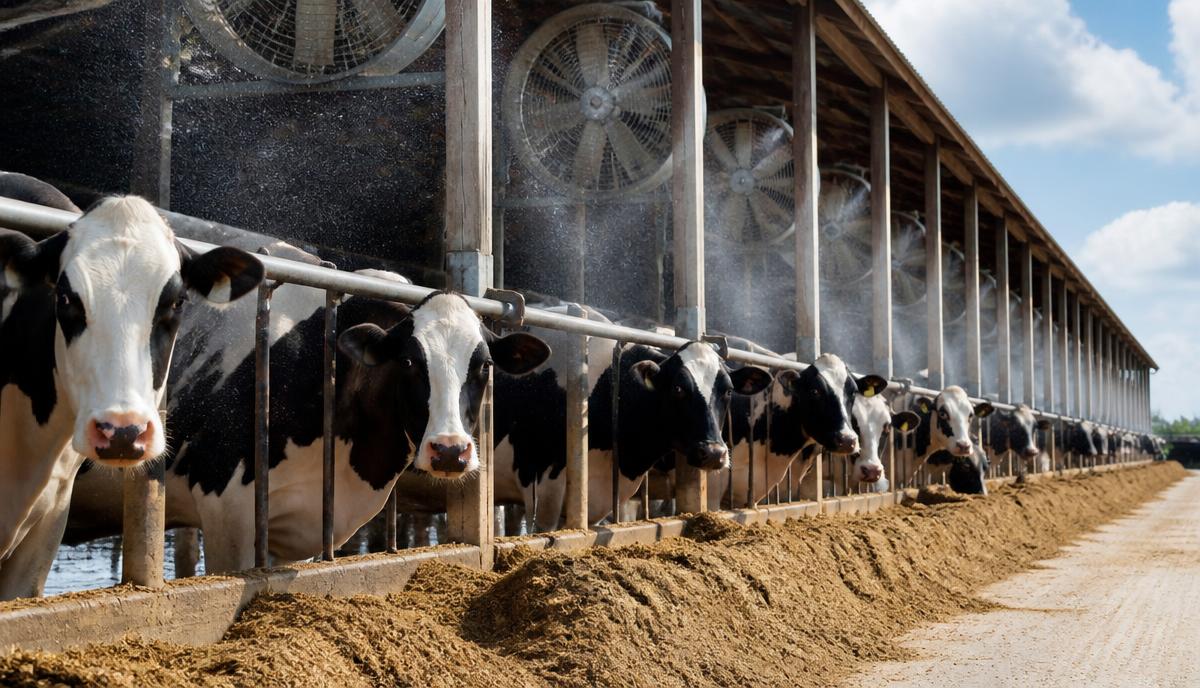
The THI-68 threshold sits well below the summer conditions Scandinavian and UK barns were designed for. Retrofit priorities that convert cooling spend into welfare and yield.
The temperature-humidity index (THI) threshold for measurable intake and yield loss in high-producing Holsteins has been repeatedly placed around 68 — a level routinely exceeded across Denmark, southern Sweden, the Netherlands and the UK during summer months in the past five years. Older literature (Zimbelman et al., 2009; West, 2003) established the physiological basis; newer work (Becker et al., 2020; Herbut et al., 2021) confirms the threshold has not moved even as genetics have.
Welfare, not just yield
Heat-stressed cows show reduced lying time, increased standing bouts and elevated respiration rates well before yield drops become visible in the tank. Polsky and von Keyserlingk (2017) frame heat stress explicitly as a welfare state, not a production problem — and the welfare signals appear one to two days ahead of the production signals.
Retrofit priorities in order
- High-volume low-speed fans over the resting area first, feed bunk second.
- Soakers at the feed bunk, activity-triggered where possible, cycling on intake peaks rather than on the clock.
- Air inlet area sized to the current herd, not the herd the barn was built for.
- Night-time ventilation to guarantee THI drops below 68 for at least six consecutive hours — recovery matters as much as peak mitigation.
The economics
Documented ECM losses in unmitigated Northern European barns during a typical summer now sit at 2–4 kg per cow per day for 40–80 days. A modest retrofit — fans plus soakers over the resting and feeding zones — typically pays back within two summers at current milk prices, before any welfare benefit is priced in.
- West, J. W. (2003). Effects of heat-stress on production in dairy cattle. Journal of Dairy Science, 86(6), 2131–2144. https://doi.org/10.3168/jds.S0022-0302(03)73803-X
- Zimbelman, R. B., Rhoads, R. P., Rhoads, M. L., Duff, G. C., Baumgard, L. H., & Collier, R. J. (2009). A re-evaluation of the impact of temperature humidity index (THI) and black globe humidity index (BGHI) on milk production in high producing dairy cows. Proceedings of the Southwest Nutrition and Management Conference, 158–169.
- Polsky, L., & von Keyserlingk, M. A. G. (2017). Invited review: Effects of heat stress on dairy cattle welfare. Journal of Dairy Science, 100(11), 8645–8657. https://doi.org/10.3168/jds.2017-12651
- Becker, C. A., Collier, R. J., & Stone, A. E. (2020). Invited review: Physiological and behavioral effects of heat stress in dairy cows. Journal of Dairy Science, 103(8), 6751–6770. https://doi.org/10.3168/jds.2019-17929
- Herbut, P., Angrecka, S., Godyń, D., & Hoffmann, G. (2021). The physiological and productivity effects of heat stress in cattle — a review. Annals of Animal Science, 21(2), 385–410. https://doi.org/10.2478/aoas-2020-0116