
A short history of dairy welfare science: from Brambell to sensor-based assessment
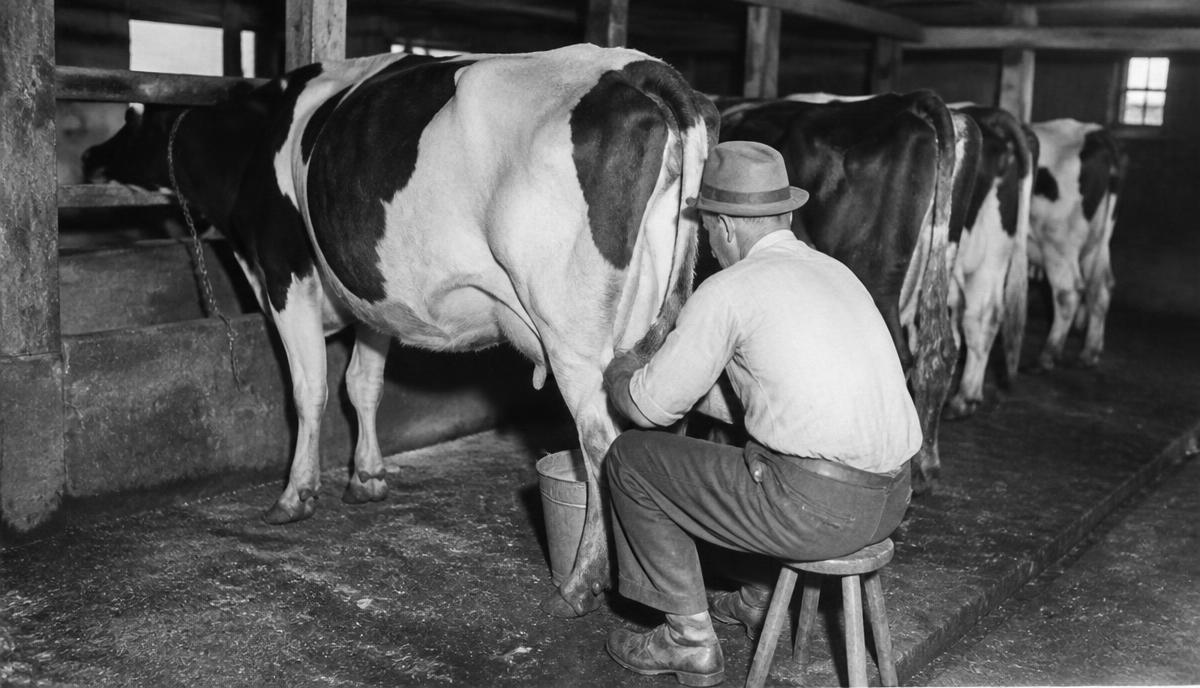
Dairy welfare science is younger than most practitioners assume. Tracing the arc from the 1965 Brambell Report through the Five Freedoms, Five Domains and modern positive-welfare frameworks.
Dairy welfare science as a distinct discipline is younger than most practitioners realise. Its foundational document is the Brambell Report (Command Paper 2836, 1965), commissioned by the UK government in response to Ruth Harrison's 1964 book Animal Machines. Brambell's committee produced the first formal statement that intensively housed farm animals should have enough freedom of movement to stand up, lie down, turn around, groom themselves and stretch their limbs — the seed of every welfare framework that followed.
The Five Freedoms
The Farm Animal Welfare Council formalised Brambell's principles into the Five Freedoms in 1979 (freedom from hunger and thirst; from discomfort; from pain, injury and disease; to express normal behaviour; from fear and distress). For thirty years these framed almost all Western welfare regulation and much of the early research programme (Webster, 2005 provides the canonical retrospective).
From negative to positive welfare
The Five Domains model, developed by Mellor and colleagues and refined into its current form in Mellor et al. (2020), reframed welfare around mental state — explicitly including positive experiences such as comfort, pleasure and agency, not just the absence of suffering. This shift underpins the contemporary interest in enrichment, choice architecture and positive affective states in dairy science.
On-farm assessment protocols
The Welfare Quality® project (Botreau et al., 2007) produced the first internationally-harmonised on-farm dairy welfare assessment protocol, combining animal-based measures across the four principles of good feeding, good housing, good health and appropriate behaviour. It remains the reference framework for most European welfare audits and has strongly influenced national programmes elsewhere.
The sensor era
- Accelerometer-based lying time became a validated welfare indicator (Ito et al., 2009).
- Rumination collars and activity monitors added continuous behavioural time-series to welfare assessment.
- Computer-vision lameness and body-condition scoring is now moving into routine on-farm use.
- The unresolved question is how automated data streams should update — rather than replace — the animal-based welfare audit.
- Brambell, F. W. R. (1965). Report of the technical committee to enquire into the welfare of animals kept under intensive livestock husbandry systems. Command Paper 2836. London: Her Majesty's Stationery Office.
- Webster, J. (2005). Animal welfare: Limping towards Eden. Oxford: Blackwell Publishing. https://doi.org/10.1002/9780470751107
- Mellor, D. J., Beausoleil, N. J., Littlewood, K. E., McLean, A. N., McGreevy, P. D., Jones, B., & Wilkins, C. (2020). The 2020 Five Domains Model: Including human–animal interactions in assessments of animal welfare. Animals, 10(10), 1870. https://doi.org/10.3390/ani10101870
- Botreau, R., Veissier, I., Butterworth, A., Bracke, M. B. M., & Keeling, L. J. (2007). Definition of criteria for overall assessment of animal welfare. Animal Welfare, 16(2), 225–228. https://doi.org/10.1017/S0962728600031390
- Ito, K., Weary, D. M., & von Keyserlingk, M. A. G. (2009). Lying behavior: Assessing within- and between-herd variation in free-stall-housed dairy cows. Journal of Dairy Science, 92(9), 4412–4420. https://doi.org/10.3168/jds.2009-2235