
Lameness prevention: from prevalence audits to a functional-trimming calendar
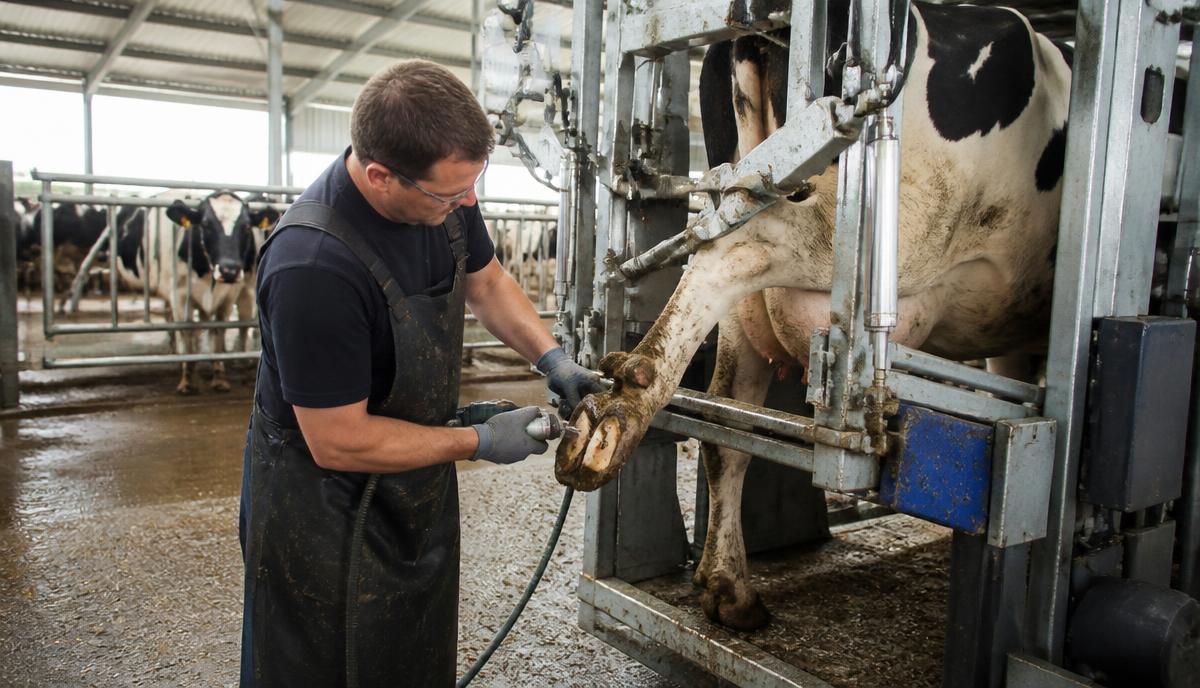
Herd-level lameness above 20% is a system failure, not a hoof problem. Combining Sprecher-style locomotion scoring with modern claw-lesion epidemiology to build a preventive trimming schedule that actually holds.
Lameness is still the most under-reported and most economically damaging welfare problem on modern dairies. Cross-country prevalence studies from the past decade repeatedly place mean freestall-herd prevalence between 20% and 35%, with the best-managed herds sitting near 10% and the worst above 50% (Cook et al., 2016; Thomsen et al., 2023).
Score before you trim
The Sprecher 1–5 locomotion scale remains the workhorse. Scoring every cow every four weeks as she exits the parlour, on a dry flat lane, produces a defensible prevalence figure and a working list for the trimmer. Farms that adopt this cadence typically see prevalence fall by 5–10 percentage points within two lactation cycles, largely by catching score-3 cows before they become chronic.
The lesion mix has shifted
The dominant claw lesions in most European and North American freestall herds are now non-infectious — sole ulcers, white line disease and toe lesions — with digital dermatitis a persistent second front. This shift, well-documented by Randall et al. (2019) and consistent with older work by Bicalho and Oikonomou (2013), means that footbath management alone cannot solve modern lameness; cushion and standing time have to be addressed in parallel.
A trimming calendar that holds
- Two whole-herd functional trims per lactation as the baseline, timed to dry-off and mid-lactation.
- Score-3 cows trimmed within seven days of detection, not at the next herd visit.
- Digital dermatitis lesions treated topically and re-checked within two weeks — never assume a single treatment resolves M2 lesions.
- Trimmer records fed back into herd software so lesion incidence is tracked, not just treatments.
- Sprecher, D. J., Hostetler, D. E., & Kaneene, J. B. (1997). A lameness scoring system that uses posture and gait to predict dairy cattle reproductive performance. Theriogenology, 47(6), 1179–1187. https://doi.org/10.1016/S0093-691X(97)00098-8
- Cook, N. B., Hess, J. P., Foy, M. R., Bennett, T. B., & Brotzman, R. L. (2016). Management characteristics, lameness, and body injuries of dairy cattle housed in high-performance dairy herds in Wisconsin. Journal of Dairy Science, 99(7), 5879–5891. https://doi.org/10.3168/jds.2016-10956
- Bicalho, R. C., & Oikonomou, G. (2013). Control and prevention of lameness associated with claw lesions in dairy cows. Livestock Science, 156(1–3), 96–105. https://doi.org/10.1016/j.livsci.2013.06.007
- Randall, L. V., Green, M. J., Green, L. E., Chagunda, M. G. G., Mason, C., Archer, S. C., & Huxley, J. N. (2019). The contribution of previous lameness events and body condition score to the occurrence of lameness in dairy herds: A study of two herds. Journal of Dairy Science, 102(2), 1449–1461. https://doi.org/10.3168/jds.2018-14964
- Thomsen, P. T., Shearer, J. K., & Houe, H. (2023). Prevalence of lameness in dairy cows: A literature review. The Veterinary Journal, 295, 105975. https://doi.org/10.1016/j.tvjl.2023.105975