Lying time as the master welfare signal: what 12 hours really means
Lying time is the single most validated behavioural indicator of dairy cow welfare. A review of thresholds, measurement pitfalls and what recent accelerometer studies add to a 20-year evidence base.
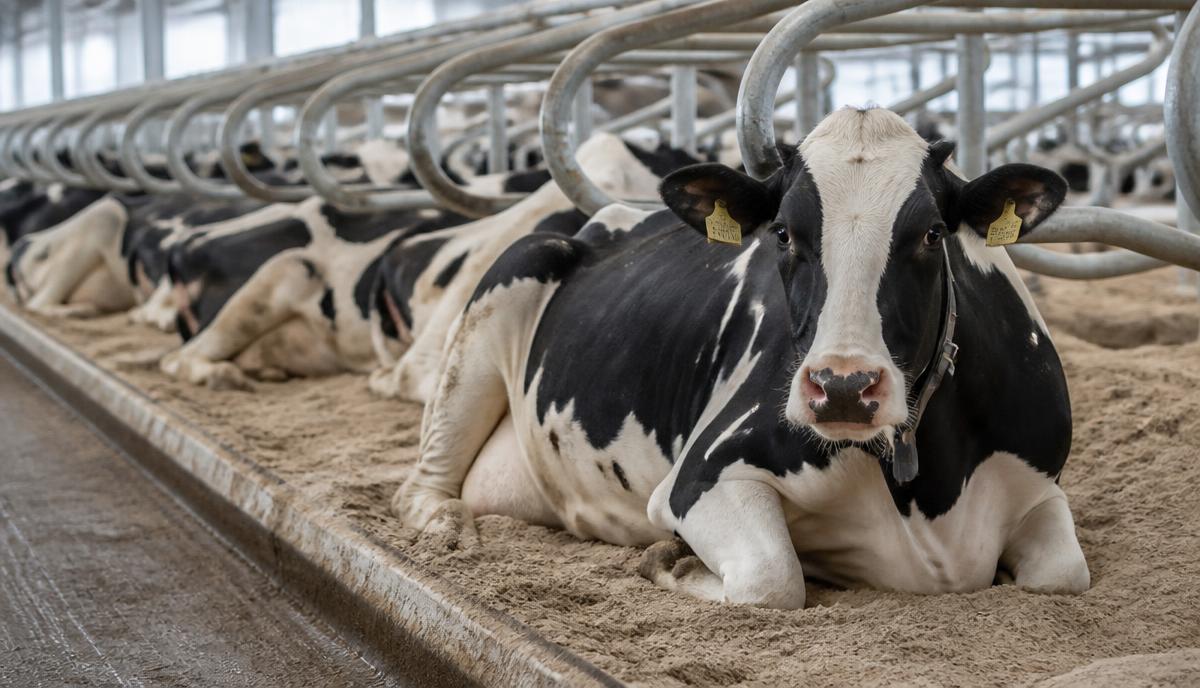
Lying time remains the most extensively validated behavioural welfare indicator in dairy cattle. Two decades of accelerometer work have converged on a broadly consistent picture: healthy, comfortable lactating Holsteins in freestall housing lie down for roughly 10–13 hours per day, distributed across 8–12 bouts. Herds sitting persistently below the 10-hour mark almost always have a resolvable housing, flooring or stocking-density problem.
The 12-hour heuristic and what it hides
Ito and colleagues (2009) established the modern reference range across 43 commercial farms, and later work by Charlton et al. (2016) and Steensels et al. (2017) has broadly confirmed it. But a herd mean of 12 hours can still hide serious welfare problems: heavily lame cows often maintain or even increase total lying time while dramatically reducing bout frequency, so the distribution matters as much as the mean.
What actually moves lying time
- Stall base and bedding depth — deep-bedded sand consistently outperforms mattresses by 60–90 minutes per day.
- Stocking density above 1.0 cows per stall reduces lying time non-linearly, with sharp losses beyond 1.2.
- Neck-rail and brisket-board positioning — small geometry errors produce large behavioural effects.
- Heat load: every unit of THI above 68 costs measurable lying time in unmitigated barns.
Reading sensor data without over-fitting
Modern accelerometer platforms report lying time to the minute, which tempts managers to react to daily noise. The evidence base supports acting on rolling 7-day means at the pen level, and on individual-cow deviations only when they persist across at least three consecutive days or coincide with a second signal such as rumination drop.
- Ito, K., Weary, D. M., & von Keyserlingk, M. A. G. (2009). Lying behavior: Assessing within- and between-herd variation in free-stall-housed dairy cows. Journal of Dairy Science, 92(9), 4412–4420. https://doi.org/10.3168/jds.2009-2235
- Tucker, C. B., Jensen, M. B., de Passillé, A. M., Hänninen, L., & Rushen, J. (2021). Invited review: Lying time and the welfare of dairy cows. Journal of Dairy Science, 104(1), 20–46. https://doi.org/10.3168/jds.2019-18074
- Charlton, G. L., Bouffard, V., Gibbons, J., Vasseur, E., Haley, D. B., Pellerin, D., Rushen, J., & de Passillé, A. M. (2016). Can automated measures of lying time help assess lameness and leg lesions on tie-stall dairy farms? Applied Animal Behaviour Science, 175, 14–22. https://doi.org/10.1016/j.applanim.2015.02.011
- Steensels, M., Antler, A., Bahr, C., Berckmans, D., Maltz, E., & Halachmi, I. (2017). A decision-tree model to detect post-calving diseases based on rumination, activity, milk yield, BW and voluntary visits to the milking robot. Animal, 11(11), 2109–2119. https://doi.org/10.1017/S1751731117000856